
Health Education Resources

- Details
- Category: Health Education Resources
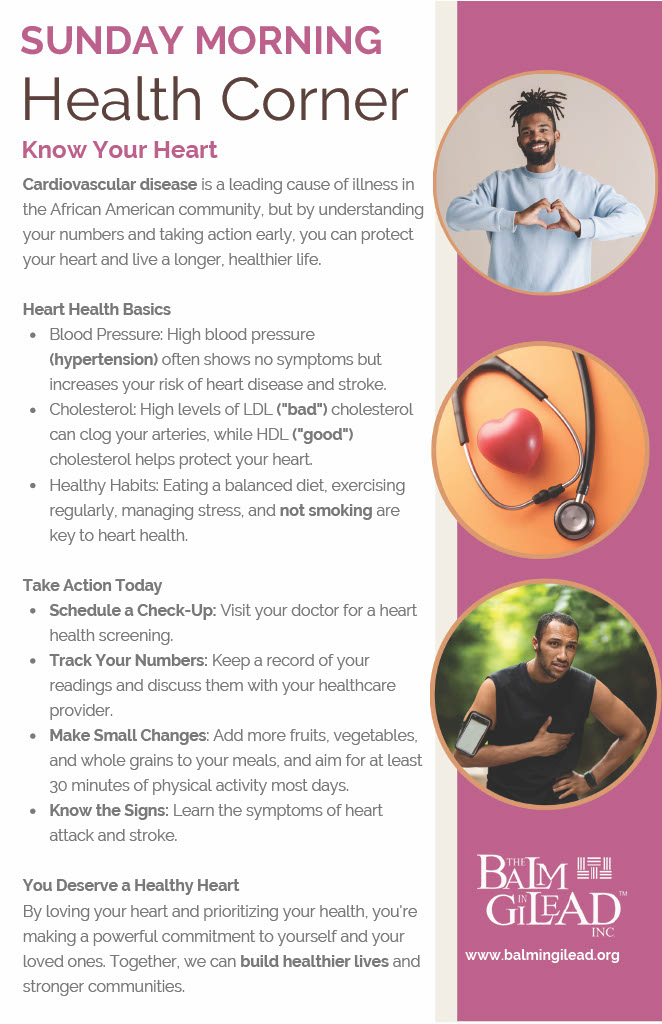
February is American Heart Month!
Did you know heart disease is the leading cause of death in the United States but impacts some communities disproportionately? Health problems that increase the risk of heart disease are common in African American communities, including high blood pressure, high cholesterol, diabetes, and being overweight. Having multiple risk factors increases the risk of heart disease. But the good news is that there’s a lot we can do to prevent it.
Did you know?
African American women 20 years and older: 81% are overweight, 58% have high blood pressure, 30% have high cholesterol, and 13% have been diagnosed with diabetes.
African American men 20 years and older: 72% are overweight, 57% have high blood pressure, 28% have high cholesterol, and 12% have been diagnosed with diabetes.
Help raise awareness about heart health among those you care about. Have conversations about heart health so they can better understand their risk factors for heart disease and take actionable steps to prevent or reduce them.
Lifestyle Tips
Here are some facts, how-to tips, and resources to inspire you and your community to work together to live a heart-healthy lifestyle.
- Be more physically active.
- Maintain a healthy weight.
- Eat a nutritious diet.
- Quit smoking.
- Reduce stress.
- Get 7-9 hours of quality sleep.
- Track your blood pressure, cholesterol, and blood sugar numbers.
You don’t have to make big changes all at once. Small steps will get you where you want to go.
For more information on keeping your heart healthy, join the Health Education Ministry on Saturday, February 14, 2026, at 10am and Sunday, February 15, 2026, immediately following service.
Sources: American Heart Association, Kaiser Permanente, National Center for Health Statistics
- Details
- Category: Health Education Resources
January marks Glaucoma Awareness Month, a crucial time to focus on eye health. Why the urgency? Glaucoma, often called the silent thief of sight, is a leading cause of irreversible blindness in the United States, yet as many as half of the people who have it don’t know they are affected.
What Is Glaucoma, and Why Does It Matter?
Glaucoma is not just one disease. It is a group of eye conditions that damage the optic nerve, the cable that sends visual information from your eye to your brain.
Early Signs and Symptoms You Should Never Ignore
Although glaucoma often develops without clear symptoms, there are warning signs that deserve urgent attention.
Subtle Changes That May Suggest Glaucoma:
- Slowly worsening peripheral (side) vision
- Trouble seeing in dim light
- Mildly blurred or patchy vision in one or both eyes
- Frequent prescription changes that don’t fully fix your vision
Because these changes are so gradual, many people miss or dismiss them. Regular eye exams are the only reliable way to catch glaucoma early.
Who Is at a Higher Risk for Glaucoma?
Anyone can develop glaucoma. Still, some people have a significantly higher risk. Knowing where you stand helps you decide how often to get checked.
Major Glaucoma Risk Factors
According to the Centers for Disease Control and Prevention, the National Eye Institute, and the Glaucoma Research Foundation, the following factors raise your risk:
- Age 60 or older (risk increases with age)
- Family history of glaucoma, especially in a parent or sibling
- Elevated eye pressure (ocular hypertension)
- Diabetes, high blood pressure, or heart disease
- Thin corneas or certain eye structural features
- A history of eye injury, long-term steroid use, or certain eye conditions
Race and ethnicity:
African American adults are more likely to develop glaucoma, and we often develop it at a younger age
Hispanic and Latino adults, particularly those over age 60, have an elevated risk. People of Asian descent are at higher risk for angle-closure glaucoma and some normal-tension forms
Studies also show that glaucoma is more likely to cause blindness in Black and Latinx populations due to biological and systemic factors, including disparities in access to eye care.
If you fall into any of these groups, Glaucoma Awareness Month is an ideal time to talk with an eye doctor.
Resources: Detecting Glaucoma with a Dilated Eye Exam; Animation: Dilated Eye Exam
Sources: Glaucoma Research Foundation, Johns Hopkins Bloomberg School of Public Health
- Details
- Category: Health Education Resources
Cervical cancer begins in the cells of the cervix, the lower part of the uterus that connects to the vagina and is almost always linked to persistent infection with high-risk human papillomavirus (HPV). While HPV is common, long-lasting infection can cause abnormal cervical cell changes that may progress into cancer if they are not detected early.
Despite advances in prevention and treatment, cervical cancer continues to pose a serious public health challenge, particularly for Black women. Black women are more than one-and-a-half times as likely to die from cervical cancer compared to their white counterparts, highlighting the urgent need to address systemic barriers related to healthcare access, awareness, and education.
Updated Cervical Cancer Screening Guidelines for 2026
The American Cancer Society (ACS) recommends beginning cervical cancer screening at age 25 for people with a cervix at average risk. The preferred screening method for ages 25 through 65 is primary HPV testing every five years. If primary HPV testing is not available, co-testing (HPV test plus Pap test) every five years or Pap testing alone every three years is acceptable. Recent ACS updates and clinical news summaries also highlight the expansion of self-collected HPV samples in approved clinical settings. Screening may end after age 65 for individuals with adequate prior normal results. With modern screening and HPV vaccination, cervical cancer is one of the most preventable cancers worldwide.
On this Cervical Cancer Awareness Month, the messages are clear.
Get informed. Find out the facts about cervical cancer and the HPV that causes it. Help educate other women in your life too.
Get screened. Cervical cancer screening typically starts at age 30 and is repeated periodically.
Get vaccinated. The HPV vaccine is given in 2 doses that should begin when a girl is between 9 and 14 years old.
Watch this short informative video
Sources: World Health Organization, American Association for Cancer Research, Mayo Clinic
- Details
- Category: Health Education Resources
January is National Blood Donor Month and is an important time to remember the life-saving power of blood donation. As the winter months bring colder weather, the celebration of holidays, severe storms, illnesses, and increased travel, donor turnout is often lower, even as patient needs are still constant. Every two seconds, someone in the United States requires a blood transfusion, with more than 42,000 units of red cells, platelets, and plasma used by patients every single day. These donations are essential for patients facing trauma, surgeries, childbirth complications, cancer treatments, chronic conditions and many other medical needs.
Blood donation from Black individuals is critical, especially for patients with sickle cell disease, as they often have unique red blood cell antigens (like the Ro subtype) that provide better matches, reducing life-threatening reactions, but there's a significant shortage of Black donors, with less than 3% of donors being Black despite making up 13% of the U.S. population.
How to Donate Blood
Simply download the American Red Cross Blood Donor App, visit RedCrossBlood.org, call 1-800-RED CROSS (1-800-733-2767) or enable the Blood Donor Skill on any Alexa Echo device to make an appointment or for more information. All blood types are needed to ensure a reliable supply for patients. A blood donor card or driver’s license or two other forms of identification are required at check-in. Individuals who are 17 years of age in most states (16 with parental consent where allowed by state law), weigh at least 110 pounds and are in generally good health may be eligible to donate blood. High school students and other donors 18 years of age and younger also have to meet certain height and weight requirements.
Sources: American Red Cross, Association for the Advancement of Blood & Biotherapies